
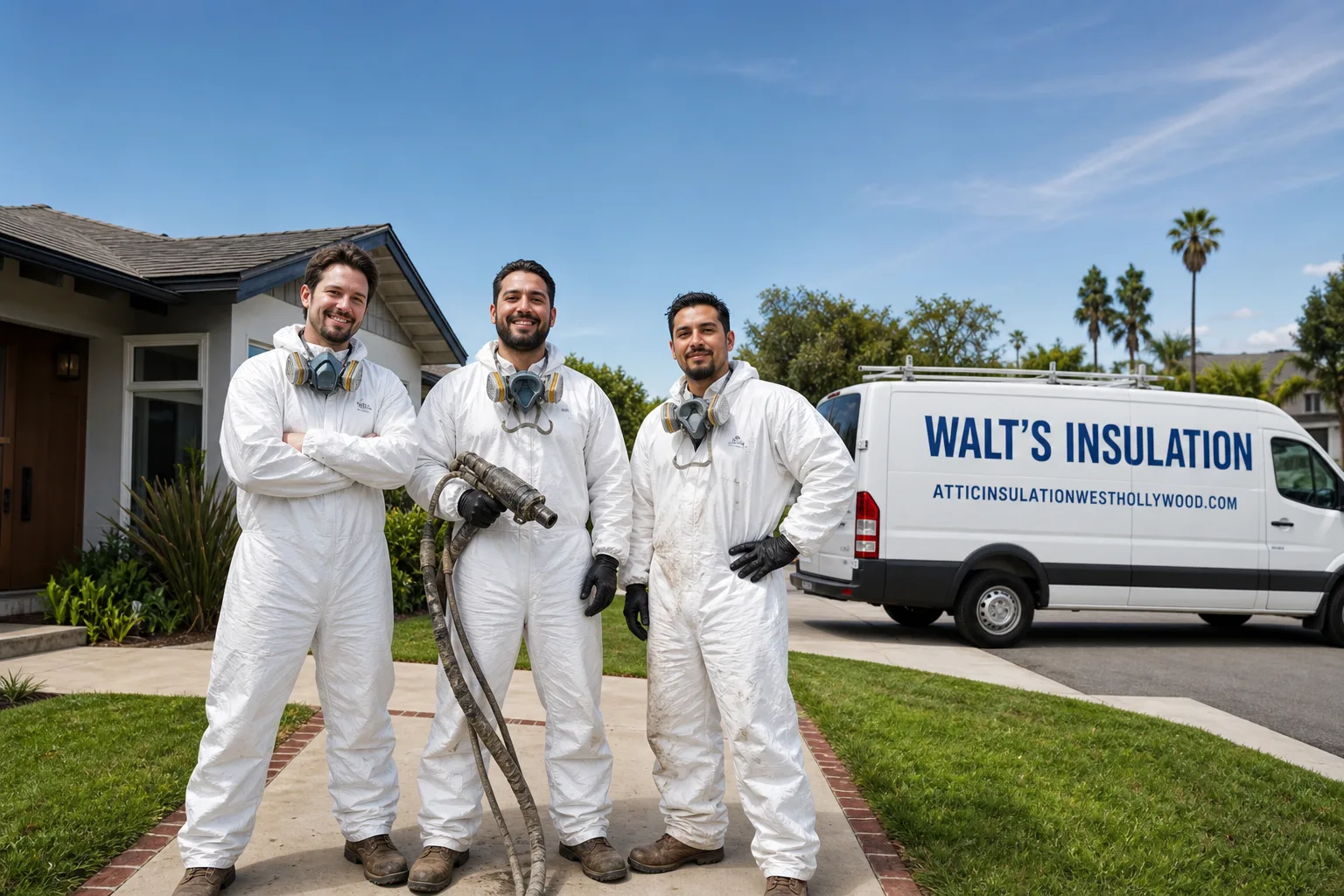
How Much Does Attic Insulation Cost in West Hollywood?
Attic Insulation Near Me in West Hollywood, CA typically costs between $1,800 and $4,500 for a standard single-family home, with most homeowners landing somewhere around $2,400 to $3,200 depending on attic size, current insulation condition, and the material used. Blown-in fiberglass or cellulose tends to be the most affordable path to hitting California’s Title 24 R-38 requirement, while spray foam runs higher but seals air gaps that batts and blown-in can’t touch. For a fast, no-obligation number specific to your home, call (213) 527-4062 – a live person picks up every time, any hour.
Attic Insulation Cost Breakdown (2026)
The table below reflects real pricing we see in the West Hollywood market in 2026. These are installed costs – materials plus labor – for a typical 1,000 to 1,500 sq ft attic. Smaller bungalows in the Norma Triangle or Santa Monica-adjacent strips will land at the lower end; larger hillside homes with complex framing near Laurel Canyon tend to push toward the top.
| Service / Material | Typical Installed Cost (WeHo Market) | Notes |
|---|---|---|
| Blown-in fiberglass (new install) | $1,800 – $2,800 | Most common upgrade path; meets Title 24 R-38 efficiently |
| Blown-in cellulose (new install) | $1,900 – $2,900 | GreenFiber or similar; good for older WeHo homes with irregular framing |
| Fiberglass batts (new install) | $1,500 – $2,400 | Lower upfront cost; less effective without proper air sealing |
| Open-cell spray foam | $2,800 – $4,200 | Icynene or Demilec; seals and insulates in one pass |
| Closed-cell spray foam | $3,500 – $5,500 | Highest R-value per inch; ideal for tight attics or roof deck application |
| Rockwool / mineral wool batts | $2,200 – $3,400 | Fire-resistant; good acoustic performance for hillside homes |
| Radiant barrier (add-on) | $800 – $1,600 | Foil barrier stapled to rafters; meaningful gain in WeHo’s warm summers |
| Old insulation removal | $600 – $1,500 | Required if existing material is wet, moldy, or rodent-contaminated |
| Attic air sealing (before new insulation) | $400 – $900 | Strongly recommended; sealing before insulating amplifies every R-value dollar |
| Full replacement (removal + air seal + blown-in) | $3,200 – $5,500 | Common scope for homes built before 1980 |
A few things push those numbers up or down in West Hollywood specifically. Homes in the older corridors near Santa Monica Boulevard or the hillside areas above Sunset Plaza often have original blown-in that has settled to R-5 or less – well below what California now requires and far below what makes sense for your utility bill. When existing insulation is in reasonable shape, adding blown-in on top (a “top-off”) can cost as little as $900 to $1,400 and get you where you need to be fast. When it’s contaminated or compacted beyond recovery, full removal is the right call even if it adds to the day’s invoice.
Attic access also matters in West Hollywood more than in most markets. The city has a higher-than-average share of Spanish Colonial and older Craftsman homes with low-pitch roofs or attics that were not built with crew access in mind. When our technicians have to work in a 24-inch clearance space instead of a full stand-up attic, that takes more time and that’s reflected honestly in the quote – no surprises after the fact.
What Affects Attic Insulation Pricing in West Hollywood
- Attic size and layout: Price is calculated per square foot, so a 2,000 sq ft attic costs more than a 900 sq ft attic to insulate. But layout matters too – a West Hollywood Spanish Colonial with a low-slope roof and multiple knee-wall cavities takes longer to work in than an open ranch-style attic, even if the square footage is similar.
- Current insulation condition: If you have old blown-in that has settled, gotten wet from a past roof leak, or been disturbed by rodents (a genuine problem in the Laurel Canyon-adjacent neighborhoods), removal adds to the job cost before new material even goes in. In West Hollywood, we regularly find 1970s-era vermiculite or low-density fiberglass that has degraded to almost no R-value – removing it is not optional in those cases.
- California Title 24 energy code requirements: Los Angeles County requires R-38 in attics for most residential applications. If your attic is at R-11, closing that gap costs more material than if you’re starting at R-19. Permits are not always required for insulation additions, but if your project triggers one (common during a larger remodel), the LA County Building and Safety permit fee typically runs $150 to $300 and is a separate line item.
- Insulation material choice: Blown-in cellulose (GreenFiber is a brand we use regularly) is priced differently than spray foam (Icynene, Demilec) or mineral wool (Rockwool). Spray foam costs more per square foot but can also eliminate the need for a separate air-sealing pass, which changes the math. We’ll walk you through the trade-offs honestly rather than defaulting to whichever material has the best margin.
- Air sealing scope: In older West Hollywood homes, the gap between living space and attic is often full of unsealed top plates, recessed light cans, and HVAC penetrations. Air sealing those before insulating is not glamorous work, but it’s where a lot of the energy savings actually come from. Expect $400 to $900 for a thorough job. Skipping it and just adding insulation is a mistake that shows up in your Edison bill.
- Radiant heat load: West Hollywood doesn’t have the summer extremes of the Inland Empire, but south-facing roof planes still absorb significant heat from May through October. A radiant barrier added to the rafter underside reduces attic temperature by 20 to 30 degrees on peak days, and in WeHo’s mild climate it often performs as well as or better than adding more blown-in above the threshold. It’s worth pricing both options side by side.
How to Save on Attic Insulation in West Hollywood
The biggest mistake West Hollywood homeowners make is treating attic insulation as a single-line commodity and calling five contractors to find the lowest number. That approach reliably produces the wrong outcome – either a bargain-priced job that skips air sealing, uses an R-value that doesn’t meet code, or disappears when something goes wrong six months later.
Here’s what actually saves money:
- Get a free second opinion on any written estimate. We offer this with no trip charge inside our service county – bring us a competitor’s written quote and we’ll tell you honestly whether it’s priced fairly and whether the scope covers what your attic actually needs. There’s no cost to do that, and it’s caught more than a few low-ball proposals that were missing air sealing or were quoting an R-value below code.
- Ask about SCE and SoCalGas rebates. Southern California Edison and SoCalGas both offer rebates for qualifying insulation upgrades. In 2026, SCE rebates for attic insulation upgrades in existing homes can reach $0.10 to $0.20 per square foot depending on the R-value increase. We’re familiar with current program requirements and can tell you whether your project is likely to qualify – that’s a conversation worth having before you sign anything.
- Bundle air sealing with insulation. Doing both in one visit costs less than two separate mobilizations and produces noticeably better results. If you’re already pulling out old insulation, that’s the right moment to seal penetrations. Don’t let a contractor skip it to hit a lower price point.
- Schedule in fall or early spring. West Hollywood’s mild climate means there’s no hard off-season, but late October through February is typically slower for insulation contractors in LA County. That’s when you’re more likely to get a faster schedule and, occasionally, better pricing.
- Ask about the senior and veteran discount. Walt’s Insulation offers a permanent 10% discount to seniors and veterans on every job, no expiration, no fine print. If that applies to you, mention it when you call – it applies to the full invoice.
- Don’t over-insulate past the code requirement without a reason. R-38 is the standard for West Hollywood. Going to R-60 is rarely cost-effective in this climate unless you have a specific energy performance target or a utility rebate that makes the math work. Spend the extra money on air sealing instead – the return is usually better.
For a free estimate with our Attic Insulation services, call (213) 527-4062. We’ll quote you a real number for your specific attic – not a ballpark built around a different house in a different ZIP code.
West Hollywood Attic Insulation: What We See on the Ground
West Hollywood’s housing stock is genuinely different from the San Fernando Valley or the South Bay, and that affects both what your attic needs and what the job is going to cost. The city is dense, with a high percentage of pre-1960 construction – Craftsman bungalows, duplexes, and Spanish Colonial-style homes that were built long before anyone thought seriously about thermal performance.
In the stretch of homes north of Santa Monica Boulevard toward the hills, we frequently find original blown-in insulation that was installed in the 1950s or 60s and has compacted down to an inch or less. At that depth, it’s doing almost nothing. The homeowners are often surprised – they knew the house had insulation, they just didn’t know it had turned into a flat mat of compressed fiberglass at the bottom of their attic floor. A proper Attic Insulation in West Hollywood project for these homes means removal, a thorough air sealing pass (those old top plates are almost never sealed), and then a fresh layer of blown-in Owens Corning or Johns Manville fiberglass or GreenFiber cellulose to get to R-38 or better.
The hillside properties above Sunset Plaza or up toward Laurel Canyon add another layer of complexity. Low-pitch roofs, irregular framing from decades of additions, and limited attic access are common. These jobs take longer and require experienced technicians – not a two-person crew from a volume operation that’s also doing six other jobs that day. Walt Brenner built this company around exactly that kind of work: jobs where the detail matters and shortcuts show up later in your energy bills or in a callback you can’t get anyone to answer.
The mild West Hollywood climate also means that attic insulation performs a little differently here than in a hotter market. You’re not fighting 115-degree summers, but you are dealing with a significant cooling load from June through September, and poorly insulated attics in WeHo can add $80 to $150 per month to your SCE bill during peak cooling season. The payback on a properly done insulation upgrade – air sealed, R-38 or better, radiant barrier if applicable – is typically four to seven years in this market. After that, it’s just savings.
Insulation Materials: Which One Makes Sense for Your West Hollywood Home?
We install products from several manufacturers and we don’t have a financial reason to push one over another. Here’s the honest version of what each does well in a West Hollywood attic:
Blown-In Fiberglass (Owens Corning, Johns Manville, Knauf)
This is the workhorse for most WeHo attic upgrades. It installs fast, covers irregular framing well, and gets to R-38 without drama. Owens Corning’s AttiCat and Johns Manville’s Climate Pro are both products we use regularly. If your attic is in reasonable shape and you’re doing a top-off or a new install on a clean deck, blown-in fiberglass is usually the most straightforward path to code compliance and a good payback period.
Blown-In Cellulose (GreenFiber)
GreenFiber cellulose is made from recycled content and performs similarly to fiberglass at comparable depth. It settles slightly over time, which is factored into install depth. Some homeowners prefer it for environmental reasons. In very old West Hollywood homes where there may be concerns about particulate matter from disturbing decades-old material, we take care to seal off living spaces before any removal or installation work.
Rockwool / Mineral Wool Batts (Rockwool)
Rockwool is heavier and denser than fiberglass batts and performs better acoustically – relevant if you’re in a duplex or a home with a shared wall situation that’s common in WeHo’s denser blocks. It’s also inherently fire-resistant. It costs more than fiberglass batts, but for certain applications it’s the right call.
Spray Foam (Icynene, Demilec)
Open-cell spray foam from Icynene or Demilec seals and insulates in a single pass – useful when air sealing is a major concern or when you want to convert a vented attic to a conditioned attic (which can make sense if HVAC equipment lives in the attic space). Closed-cell spray foam delivers the highest R-value per inch and is sometimes the only practical option in very low-clearance attic situations. It costs more, and that cost is real – but for the right attic, it eliminates problems that cheaper materials can’t solve.
Radiant Barriers (CertainTeed and others)
A foil radiant barrier isn’t insulation in the traditional R-value sense – it reflects radiant heat away from the attic floor rather than slowing conductive transfer. In West Hollywood’s climate, where radiant heat from the roof is a bigger seasonal factor than extreme cold, a radiant barrier paired with blown-in at R-38 often outperforms R-49 blown-in alone during summer months. We price both options so you can make an informed decision.
Do You Need a Permit for Attic Insulation in West Hollywood?
West Hollywood falls under LA County Building and Safety jurisdiction for most residential permits. Adding insulation to an existing attic – a top-off or a straight replacement – typically does not require a permit in Los Angeles County when it’s a like-for-like insulation job. However, if you’re doing a full attic renovation, converting a vented attic to a conditioned space, or the insulation work is part of a larger remodel, a permit is likely required.
If a permit is needed, the application and inspection process is handled through LA County LADBS. We’re familiar with the process and can advise you on whether your specific project scope triggers a permit requirement before we start. We don’t skip permits to save time – that’s the kind of shortcut that creates problems when you sell the home.
California’s Title 24 Part 6 energy code requires R-38 in attics for climate zone 9, which covers West Hollywood. That’s the minimum we install to – not because the state requires it, but because anything less doesn’t make sense for your long-term energy costs.
FAQs: Attic Insulation Cost in West Hollywood
How much does attic insulation cost in West Hollywood in 2026?
Most West Hollywood homeowners pay between $1,800 and $4,500 for a complete attic insulation project, with the most common range landing between $2,400 and $3,200 for a 1,000 to 1,500 sq ft attic using blown-in fiberglass or cellulose. Spray foam projects run higher, typically $3,000 to $5,500 depending on attic size and foam type. The wide range exists because attic condition, access difficulty, and whether removal is needed all vary significantly from house to house in West Hollywood’s older housing stock. Call (213) 527-4062 for a free estimate specific to your home.
Is it cheaper to add insulation on top of existing insulation or remove and replace?
Adding on top – a “top-off” – runs $900 to $1,400 for most West Hollywood attics and is the right call when existing insulation is dry, intact, and at least marginally functional. Removal and replacement costs $3,200 to $5,500 for a full scope job including air sealing, but it’s the correct choice when old insulation is wet, compacted to near nothing, contaminated by rodents, or made of a material (like old vermiculite) that creates its own problems. We’ll tell you honestly which situation you’re in – we have no reason to upsell removal if a top-off will do the job properly.
What R-value do I need for my attic in West Hollywood?
California’s Title 24 energy code requires R-38 for attics in climate zone 9, which includes West Hollywood. Most homes built before 1980 are well below that – we regularly find attics sitting at R-8 to R-14 in the older Craftsman and Spanish Colonial homes throughout the city. Going above R-38 (to R-49 or R-60) is rarely cost-effective in West Hollywood’s mild climate unless you’re chasing a specific utility rebate or energy certification. Spend the extra money on air sealing first – the return on that dollar is almost always better in this market.
Can I get a rebate from SCE or SoCalGas for attic insulation in West Hollywood?
Yes – Southern California Edison and SoCalGas both offer rebates for qualifying attic insulation upgrades in existing homes. In 2026, SCE rebates for insulation have ranged from $0.10 to $0.20 per square foot depending on the R-value increase and program availability. Requirements change periodically, so we recommend asking about current program status when you call us for an estimate. We’re familiar with what qualifies and can factor expected rebates into the true cost of your project.
How long does an attic insulation job take in West Hollywood?
A straightforward blown-in installation or top-off for a typical West Hollywood home takes half a day to a full day – usually three to five hours of on-site work. If the job includes old insulation removal, extensive air sealing, or a complex attic layout (which is common in the hillside properties above Sunset Plaza), plan for a full day. We don’t rush the air sealing step to hit an early exit time – that’s the part that actually makes the insulation perform the way it should.
Does Walt’s Insulation offer a warranty on attic insulation work in West Hollywood?
Every job is covered by the Done Right Promise – a lifetime workmanship guarantee. If something we installed or sealed isn’t performing the way it should, we come back and make it right. No runaround, no passing the blame to the manufacturer. Walt Brenner has built this company’s reputation in West Hollywood and the surrounding LA communities since 2000 on exactly that kind of accountability – a real name, a real address, and a guarantee that means something.
Why West Hollywood Homeowners Call Walt’s
We’re not the cheapest option in every situation and we don’t try to be. What we are is a locally owned, owner-operated business that has been doing this work since 2000, answers the phone live at any hour, sends background-checked technicians in uniform, and backs every single job with the Done Right Promise. Walt Brenner’s name is on this company and on every estimate – that’s accountability you don’t get from a franchise or a call center with a local phone number.
If you’ve had a contractor quote you something vague, show up with a different crew than the one you met, or stop returning calls after you paid – you know why that specific kind of frustration led you here. That’s the problem we built this company to solve. Learn more about our work on our home page, or go straight to our dedicated Attic Insulation in West Hollywood service page for full details on what a job with us actually looks like.
We serve West Hollywood and the surrounding communities across LA County. No trip charge inside our service county. Free second opinion on any written estimate. Ten percent off for seniors and veterans, always. $40 off any repair over $200.
Call (213) 527-4062 – a live person picks up every time, and we’ll give you a real number for your specific attic, not a range pulled from a different market.
Pricing reflects the West Hollywood market as of 2026. Walt’s Insulation offers free estimates – call (213) 527-4062.
Written by Walt Brenner, Owner at Walt’s Insulation, serving West Hollywood since 2000.
What Our Customers Say
"Crawl space was wet every spring. They laid the heavy liner, sealed the vents, and put a dehumidifier down there. Floors are warm and the moisture meter he left reads fine now. He still answers when I text him a reading."
- Devon Pierce"Spray foam in the garage ceiling under the bonus room. That room used to be unusable in summer. Walt talked me out of foaming the whole attic because it did not need it - saved me a couple thousand and I trust him more for it."
- Bud Larkin"The house had rats in the attic insulation and a smell we could not place. Walt's crew pulled all of it, sealed the gaps where they were getting in, sanitized, and put in new blown-in. He sent photos of the sealed openings so I could see it done."
- Rosa Delgado